Designed around how you use power today.
And how you'll use it tomorrow.
Engineer-led solar and battery systems for Melbourne homes and businesses.
Engineer-led solar and battery systems for Melbourne homes and businesses.
We don't start with the panels and battery.
We start with your power bill.
Most solar quotes start with a product — a panel, an inverter, a battery, a package size — and then try to make your property fit it.
We work the other way around. For a home, that starts with your power bill and how your household uses electricity through the day. For a business, it means looking at your consumption data, your operating hours, your site, your electrical infrastructure, and where things are headed. Only then do we work out whether solar makes sense, whether a battery is justified, and what size actually fits.
If you run a factory, warehouse, pub, club or similar commercial property, electricity is probably one of your biggest controllable costs — and one of the easiest things to get wrong when it comes to solar.
We start with your bill and your load: how much power you use, when you use it, and how that splits between day and night. Then we look at your site, your existing electrical infrastructure and switchboard, and where your business is headed. From there we work out whether solar, battery storage, EV charging — or some combination — actually stacks up. If it doesn't, we'll tell you that too.
Most homeowners spend somewhere between $300 and $1,000 a month on electricity, and every household uses power differently. We don't sell fixed packages — we look at your bill and your usage, then size a system around what your home needs now, and what it's likely to need as things change, like an EV or higher household use down the track.
A system that's oversized costs you more upfront than you needed to spend. A system that's undersized means you keep paying for grid power you could have avoided, and may need upgrading sooner than expected. Getting the size right means looking at today's load and any changes you can reasonably expect — an EV, a growing business — without trying to guess a decade ahead.
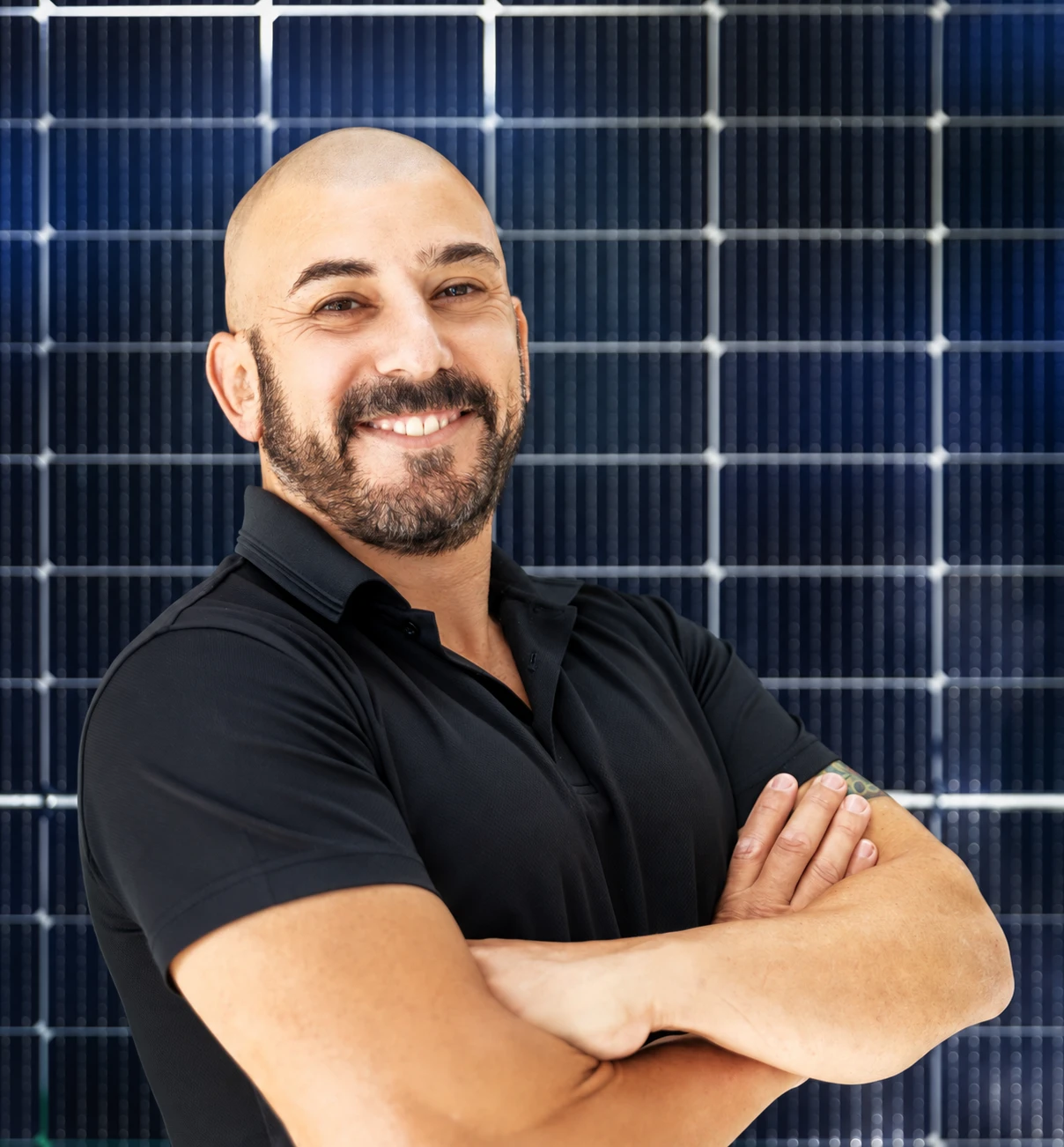
I'm a Chartered Professional Engineer, an electrical engineer, and registered RPEQ and RPEV. I've worked in the electrical industry for more than 25 years — starting in electrical engineering, including high-voltage transmission and distribution infrastructure design, before spending the last decade or so focused specifically on solar, battery storage and EV energy solutions.
Over that time I've personally designed or supervised the delivery of more than 2,500 solar and battery installations — experience that adds up to more than 25 MW of solar and around 10 MWh of battery storage.
I started this business because too many solar and battery systems are designed by sales consultants without an electrical engineering background, built around whatever's being promoted that month rather than how the customer actually uses power. I wanted to do it properly — starting with the electricity, not the equipment.
 Chartered Professional Engineer
RPEQ Registered
RPEV Registered
Chartered Professional Engineer
RPEQ Registered
RPEV Registered
The installation figures above reflect Ian's engineering career prior to founding this business — not completed projects of the business itself.
Speak to IanA recent electricity bill gives us a real starting point — how much you use, and when.
Free, by phone, video call, or a site visit where it makes sense — we get to know how you actually use power.
Solar, battery, EV charging, or a combination — sized to fit, not to impress.
What it costs, what it's likely to save, and whether it's genuinely worth doing.
We source the equipment and arrange installation through licensed, accredited installation partners.
One point of contact from design through installation and aftercare — not a list of people to chase.
We currently work primarily with Jinko Solar and LONGi panels, and Sungrow inverters and batteries. We didn't pick them because they're the cheapest or claim to be the best in the world — we picked them because they have a track record in Australian conditions, established local support, and we're comfortable standing behind them. Equipment is the last decision we make, not the first.
We're not trying to put solar on every roof or a battery in every business. Particularly for commercial projects, the numbers need to genuinely stack up. If they don't, we'd rather tell you upfront than sell you a system that doesn't pay for itself.
Free energy assessment — by phone, video call, or on-site.